Compatibilité avec la stérilisation des systèmes de barrière stérile
Technical White Paper
1. Introduction
The compatibility between sterile barrier systems (SBS) and sterilization processes is a critical engineering consideration in medical device packaging design. Inappropriate material-process combinations may lead to insufficient sterilant penetration, material degradation, or loss of microbial barrier integrity.
This technical white paper focuses on material compatibility principles for commonly applied sterilization technologies, with particular emphasis on ethylene oxide (EtO) and low-temperature sterilization processes used for complex and heat-sensitive medical devices.
2. Sterile Barrier System Requirements
- Permeability to the selected sterilizing agent
- Resistance to thermal, physical, and chemical stresses
- Post-sterilization microbial barrier integrity
- Stability during storage, transport, and handling
3. Sterilization Processes and SAL Considerations
Sterilization processes are validated to achieve a defined Sterility Assurance Level (SAL), typically 10-6 for medical devices. Achieving this level of assurance requires alignment between device design, packaging materials, and sterilization system capability.
4. Overview of Applicable Sterilization Technologies
4.1 Ethylene Oxide (EtO) Sterilization
Ethylene oxide sterilization is widely applied for devices sensitive to heat and moisture. Typical EtO processes operate at 30–60 °C under controlled humidity conditions, enabling effective sterilization of complex geometries and porous packaging systems.
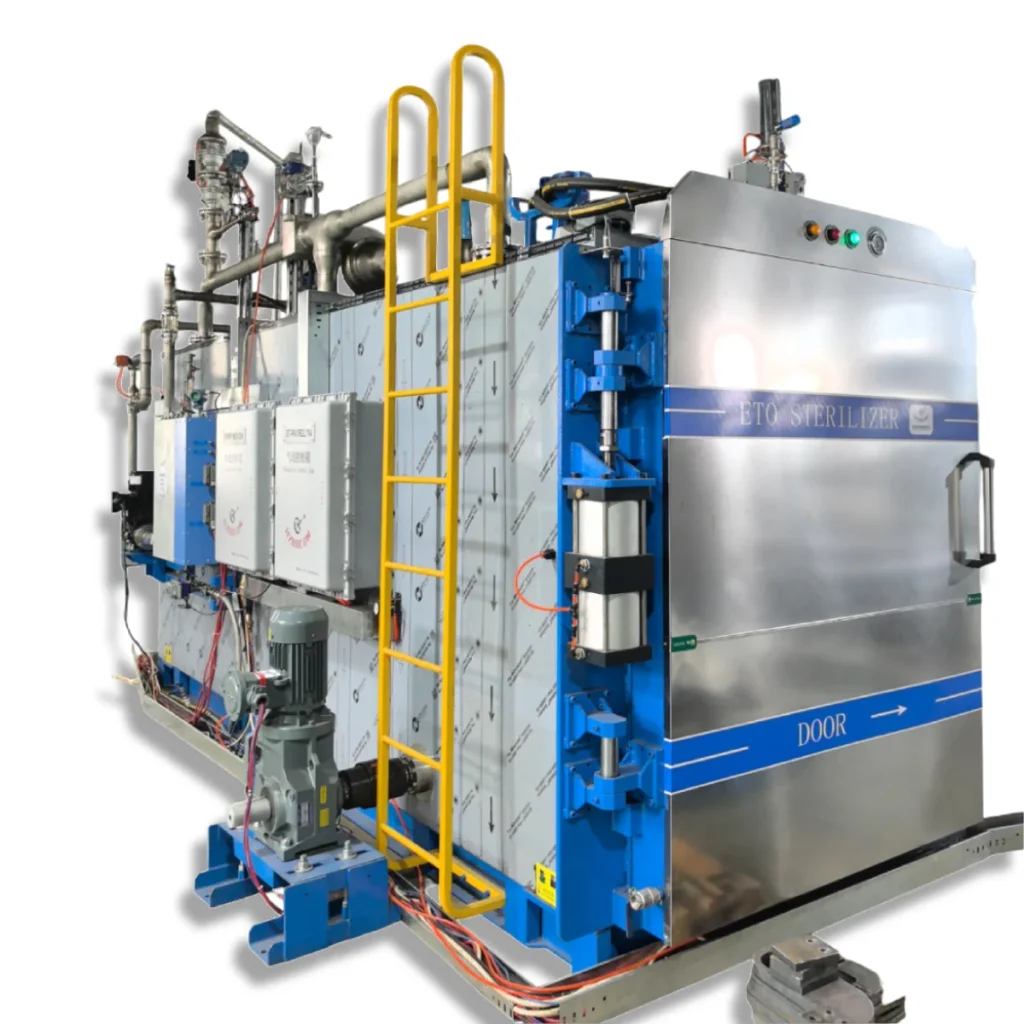
From an engineering perspective, industrial ethylene oxide sterilization systems are designed as integrated solutions combining sterilization chambers, gas circulation, humidity control, and emission management.
4.2 Low-Temperature Oxidative Sterilization
Vaporized hydrogen peroxide (VHP) and hydrogen peroxide gas plasma systems provide rapid cycle times and low operating temperatures. However, their strong oxidative properties impose stricter limitations on compatible packaging materials compared with EtO sterilization.
5. Material Compatibility Analysis
5.1 Porous Materials for Gas Sterilization
Medical grade paper and polyolefin non-woven materials are commonly used in sterile barrier systems for EtO sterilization due to their controlled porosity and ability to maintain microbial barrier performance after sterilization.
5.2 Films and Composite Structures
Impermeable films and laminated composite materials are widely used in pouches, reels, and blister packaging. Compatibility depends on polymer composition, laminate structure, and resistance to sterilization-induced thermal and chemical stress.
6. Engineering Implications for Sterilization System Design
Packaging material compatibility must be evaluated together with sterilizer performance, including gas distribution uniformity, load configuration, and post-sterilization aeration efficiency.
This is particularly important for large-scale production using industrial EtO sterilization equipment , where process robustness and residue control are critical.
7. Engineering Capability Statement
Engineering teams delivering EtO sterilization systems must integrate packaging compatibility considerations into system design, validation strategy, and environmental control.
Download
Download the BOCON Ethylene Oxide Sterilizer Product Catalog (PDF)
| Comparison Aspect | Oxyde d'éthylène (EtO) | VHP / H?O? Plasma | Engineering Implications |
|---|---|---|---|
| Operating Temperature | 30–60 °C | < 60 °C | Both suitable for heat-sensitive devices |
| Packaging Material Range | Broad | Limited | EtO compatible with most porous materials |
| Compatibility with Cellulose | Suitable | Not Suitable | Cellulose reacts with hydrogen peroxide |
| Penetration Capability | High | Limited | EtO penetrates complex loads more effectively |
| Cycle Time | Long | Short | EtO requires aeration; VHP optimized for speed |
| Residual Risk | Requires control | Minimal | EtO needs validated aeration |
| Load Complexity | High tolerance | Limited | VHP penetration constraints |
| Material Degradation Risk | Low | Modéré | Oxidative stress affects polymers |
| Typical Applications | Complex medical devices | Simple, low-mass devices | Process selection driven by design constraints |
| Packaging Design Flexibility | High | Restricted | EtO allows wider material selection |
This comparison highlights that sterilization method selection must consider packaging material compatibility, load complexity, and residual management requirements in addition to cycle time.