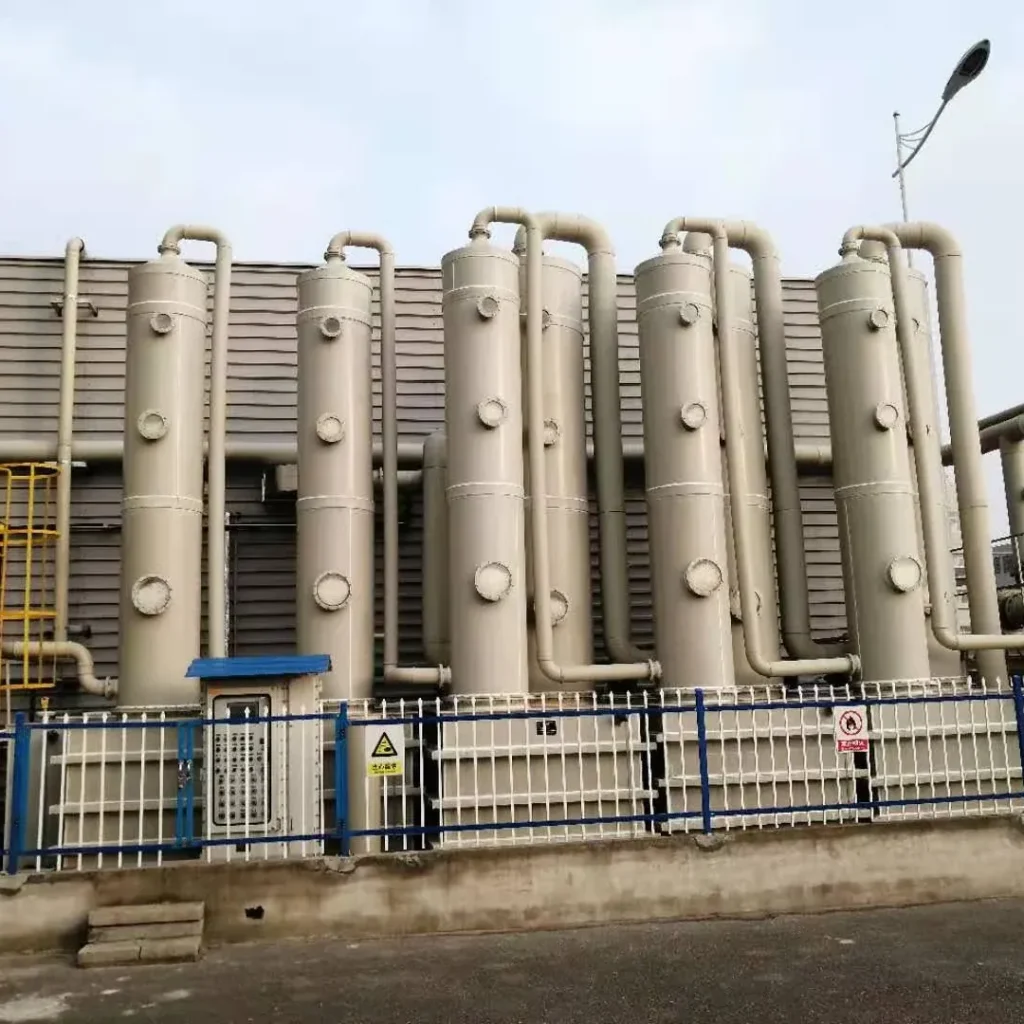
Effective EtO emissions control is essential for sterilization, chemical manufacturing, and industrial operations handling ethylene oxide (EtO). Modern abatement technologies help facilities meet regulatory requirements, improve safety, and minimize environmental impact. This guide provides an optimized, SEO-ready overview of primary EtO control technologies, including wet scrubbers, thermal oxidizers, dry bed scrubbers, catalytic oxidizers, flares, bubbling scrubbers, and integration considerations.
5.1 EO Scrubber / Packed Tower
Wet scrubbers, also known as packed towers, are effective devices for removing pollutants like EtO from industrial gas streams. These systems utilize a low-pH scrubbing liquid—typically a water and acid mixture—to absorb EtO. The acid catalyzes the conversion of EtO into Monoethylene Glycol (MEG).
How It Works: Contaminated gas enters the bottom of the tower and flows upward through a bed of packing material. Simultaneously, spray nozzles distribute the scrubbing liquid evenly downward over the packing. This design maximizes gas-liquid contact surface area, ensuring efficient absorption. The packing material, made from EtO- and acid-resistant plastics or metals, randomizes gas flow and promotes liquid dispersion via surface tension. A mist eliminator at the top captures any entrained droplets before clean air exits. The absorbed EtO, now in liquid form, collects in a reservoir at the tower bottom and is pumped to a holding tank for complete conversion to MEG.
Key Design Factor: The primary variable determining tower size is the airflow rate; the packed bed must provide sufficient residence time for complete EtO absorption. Consistent control relies on maintaining stable liquid flow rates and pH levels.
Advantages:
- Handles high-temperature and high-humidity gas streams.
- Minimal fire or explosion risk.
- Capable of treating large air volumes.
- Can achieve >99% destruction efficiency for high inlet concentrations.
Disadvantages:
- Corrosion potential from acidic liquid and carryover.
- Risk of piping freeze-up in cold climates.
- Potential fouling of packing and liquid due to poor water quality.
- High power consumption.
- Requires waste liquid disposal and ongoing acid replenishment.
- Safety precautions needed for maintenance.
5.2 Thermal Oxidizers
Thermal oxidizers destroy volatile organic compounds (VOCs), including EtO and other hazardous air pollutants (HAPs), through high-temperature combustion. Systems operate between 760°C (1,400°F) and 820°C (1,510°F), converting pollutants into carbon dioxide (CO?) and water vapor.
How It Works: For safety, high-concentration EtO streams are first routed through a water balancing tank or flame arrester. The gas then enters a combustion chamber where natural gas burners initiate oxidation; the EtO itself contributes to the heat release. In regenerative thermal oxidizers (RTOs), ceramic heat exchangers capture and reuse energy from the exhaust, significantly improving fuel efficiency. The EtO-laden air is held at high temperature for a designed residence time to ensure complete oxidation before release.
Advantages:
- Very high (>99%) destruction efficiency for concentrated streams.
- Relatively small physical footprint.
- Potential for energy recovery (especially in RTOs).
- Simple operational mechanics.
Disadvantages:
- Not suitable for very high airflow, low-concentration streams.
- High fuel gas consumption (unless regenerative).
- Potential safety concerns regarding explosion risks.
- May produce nitrogen oxides (NOx) as combustion byproducts.
5.3 Dry Bed Scrubber
Dry bed scrubbers use vessels filled with chemically impregnated polymer beads (reactant media) to permanently remove EtO via chemisorption and chemical reaction, converting it into a harmless polymer.
How It Works: Contaminated air passes through the fixed bed of media, where EtO molecules adhere to the bead surfaces and react. The system is sized to provide adequate residence time for the reaction at a specific airflow rate. A support screen at the bed’s outlet prevents media carryover. These systems are highly effective, achieving >99% destruction efficiency for inlet concentrations above ~5 ppmv.
Advantages:
- Modular design allows for easy expansion.
- Low operational complexity; only requires a fan.
- Lower capital and operating cost compared to some systems.
- Permanent EtO conversion; generates non-hazardous waste.
- Safe operation and maintenance.
Disadvantages:
- Cannot handle streams with excessive humidity or high temperature.
- Media has finite capacity and requires periodic replacement.
- Not suitable for concentrations >5,000 ppmv due to exothermic reaction risks.
5.4 Thermal Flare
Flares are used in refineries, chemical plants, and similar facilities to safely destroy EtO from process vents, safety valve releases, or combined waste streams in closed-vent systems.
How It Works: A pilot flame, sustained by fuel gas, is maintained at all times. The EtO stream (often vaporized and diluted) is introduced into this combustion zone. The system constantly monitors and adjusts the burn rate to maintain a minimum net heating value, ensuring stable combustion and >99% destruction efficiency. The EtO breaks down into CO? and water. Flares can be vertical or horizontal, with some models incorporating waste-heat recovery systems.
Advantages:
- Can handle highly variable, intermittent, or complex mixed streams.
- Effective for high-energy, high-VOC processes.
- Potential for heat recovery.
Disadvantages:
- Very high fuel/utility usage.
- Visible flame may cause light pollution or public concern.
- Complex maintenance and integration.
- Risk of flashback, requiring safeguards like flame arresters, purge systems, and velocity monitoring.
5.5 Bubbling Scrubbers
Bubbling scrubbers, or bubble tank scrubbers, use a low-pH acid/water solution to chemically convert EtO to MEG through a direct bubbling contact method.
How It Works: Low-flow EtO gas is pumped to the bottom of a series of reaction tanks (often two stages). Perforated diffusers create fine bubbles that rise through the liquid, providing residence time for the reaction to occur. A centrifugal blower maintains negative pressure, pushing gases through the stages. As MEG is produced, the liquid level and specific gravity rise, which are key monitoring parameters. Tanks are periodically regenerated by transferring the MEG solution for neutralization and disposal.
Advantages:
- Intrinsically safe liquid-based system.
- High (99-99.9%) efficiency for high-concentration, low-flow streams.
- Simple design with few points of failure.
- Consistent control when parameters are stable.
Disadvantages:
- Not suitable for high-airflow applications.
- Involves handling of acids and bases.
- Ongoing cost for acid and waste MEG solution management.
- ಗಮನಿಸಿ: Distinct from passive balancing tanks (peak shavers) which only store, not treat, EtO-laden water.
5.6 Catalytic Oxidizer
Catalytic oxidizers control VOCs like EtO by promoting oxidation at temperatures significantly lower than thermal oxidizers, using a precious metal or metal oxide catalyst.
How It Works: The process gas is heated to a catalyst activation temperature (typically 150°C to 400°C / 300°F to 750°F) before passing over the catalyst bed. In the presence of excess oxygen, the catalyst promotes the complete oxidation of EtO to CO? and water vapor. Heat exchangers can be added for energy recovery. This technology is ideal for low-concentration EtO streams.
Advantages:
- Lower operating temperatures mean reduced fuel consumption and higher energy efficiency.
- Minimizes formation of thermal NOx and CO.
- Can achieve 99-99.9% destruction efficiency.
- More environmentally friendly operation.
Disadvantages:
- Catalyst is sensitive to poisoning from sulfur, silicon, phosphorous, or heavy metals.
- Generally larger footprint than thermal oxidizers.
- Higher capital cost and periodic catalyst replacement expense.
ನೀವು ಇನ್ನಷ್ಟು ತಿಳಿದುಕೊಳ್ಳಲು ಬಯಸಿದರೆ
ಫೋನ್:+8619975258603
ಇಮೇಲ್:hayley@hzbocon.com
ಸ್ಥಳೀಯ ಸೈಟ್: ಕೊಠಡಿ 1202, ಕೈಟಾಂಗ್ ಝೊಂಗ್ಕ್ಸಿನ್, ಕ್ಸಿಯಾಶಾ ಜಿಲ್ಲೆ, ಹ್ಯಾಂಗ್ಝೌ ನಗರ, ಝೆಜಿಯಾಂಗ್ ಪ್ರಾಂತ್ಯ, ಚೀನಾ
ವೆಬ್ಸೈಟ್: hzbocon.com