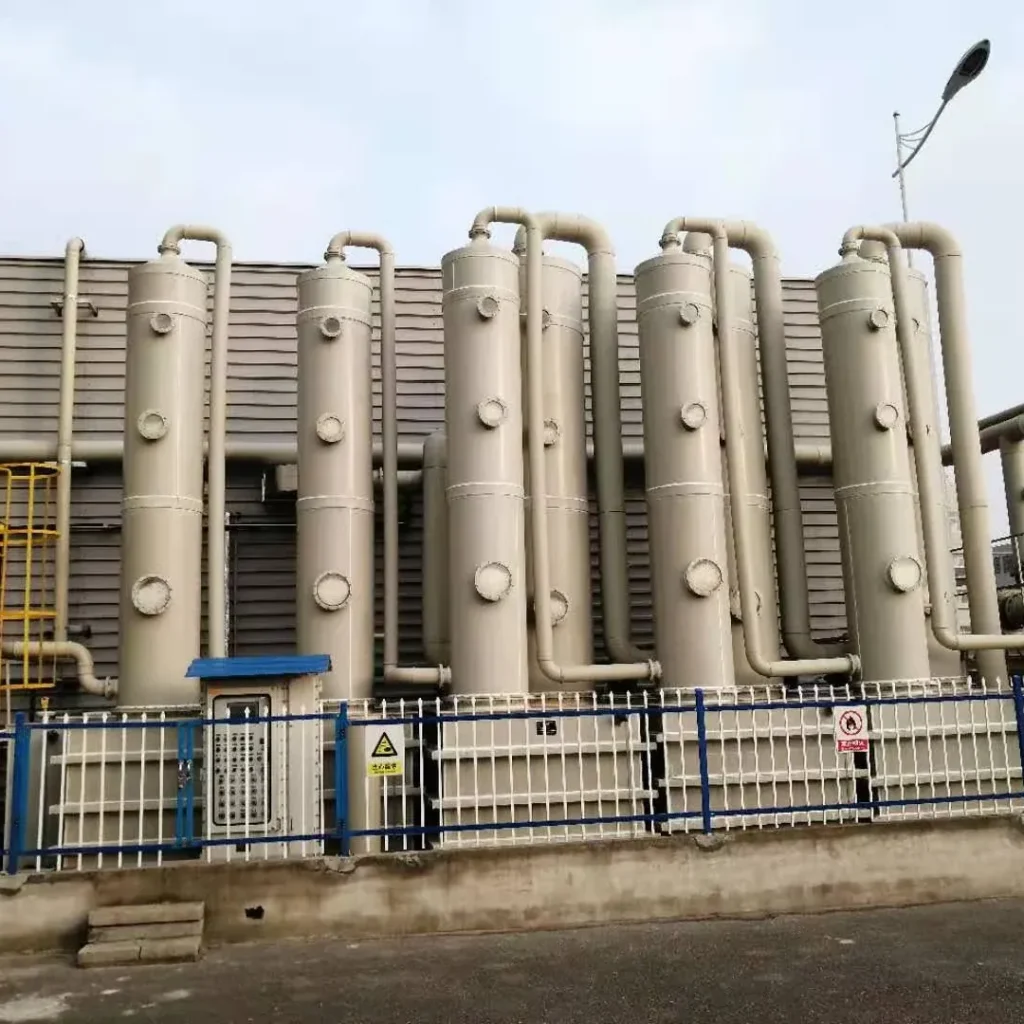
Effektief EtO-emissiebeheer is noodsaaklik vir sterilisasie, chemiese vervaardiging en industriële bedrywighede hantering etileenoksied (EtO). Moderne verligtingstegnologieë help fasiliteite om aan regulatoriese vereistes te voldoen, veiligheid te verbeter en omgewingsimpak te verminder. Hierdie gids bied 'n oorsig van primêre EtO beheer tegnologieë, insluitend nat scrubbers, termiese oksideerders, droë bed scrubbers, katalitiese oksideerders, fakkels, borrelende scrubbers en integrasie oorwegings.
5.1 EO Skrop / Gepakte toring
Nat scrubbers, ook bekend as gepakte torings, is effektiewe toestelle om besoedelingstowwe soos EtO uit industriële gasstrome te verwyder. Hierdie stelsels gebruik 'n lae-pH-skropvloeistof - tipies 'n water- en suurmengsel - om EtO te absorbeer. Die suur kataliseer die omskakeling van EtO in Monoethylene Glycol (MEG).
Hoe dit werk: Besoedelde gas kom die onderkant van die toring binne en vloei opwaarts deur 'n bed van verpakkingsmateriaal. Terselfdertyd versprei spuitpunte die skropvloeistof eweredig afwaarts oor die verpakking. Hierdie ontwerp maksimeer gas-vloeistof kontakoppervlakte, wat doeltreffende absorpsie verseker. Die verpakkingsmateriaal, gemaak van EtO- en suurbestande plastiek of metale, maak gasvloei ewekansig en bevorder vloeistofverspreiding via oppervlakspanning. ’n Mis-uitskakelaar aan die bokant vang enige meegesleurde druppels op voordat skoon lug uitkom. Die geabsorbeerde EtO, nou in vloeibare vorm, versamel in 'n reservoir aan die onderkant van die toring en word na 'n houtenk gepomp vir volledige omskakeling na MEG.
Sleutelontwerpfaktor: Die primêre veranderlike wat toringgrootte bepaal, is die lugvloeitempo; die gepakte bed moet voldoende verblyftyd bied vir volledige EtO-absorpsie. Konsekwente beheer maak staat op die handhawing van stabiele vloeistofvloeitempo en pH-vlakke.
Voordele:
- Hanteer hoë-temperatuur en hoë humiditeit gasstrome.
- Minimale brand- of ontploffingsrisiko.
- In staat om groot lugvolumes te behandel.
- Kan bereik >99% vernietigingsdoeltreffendheid vir hoë inlaatkonsentrasies.
Nadele:
- Korrosiepotensiaal van suur vloeistof en oordrag.
- Risiko van bevriesing van pype in koue klimate.
- Potensiële vervuiling van verpakking en vloeistof as gevolg van swak waterkwaliteit.
- Hoë kragverbruik.
- Vereis wegdoen van afvalvloeistof en deurlopende suuraanvulling.
- Veiligheidsmaatreëls benodig vir instandhouding.
5.2 Termiese oksideermiddels
Termiese oksideerders vernietig vlugtige organiese verbindings (VOC's), insluitend EtO en ander gevaarlike lugbesoedeling (HAP's), deur hoë-temperatuur verbranding. Stelsels werk tussen 760 °C (1 400 ° F) en 820 ° C (1 510 ° F), wat besoedelingstowwe in koolstofdioksied (CO?) en waterdamp omskakel.
Hoe dit werk: Vir veiligheid word hoë-konsentrasie EtO-strome eers deur 'n waterbalanseringstenk of vlamvanger gelei. Die gas gaan dan 'n verbrandingskamer binne waar aardgasbranders oksidasie inisieer; die EtO self dra by tot die hitte vrystelling. In regeneratiewe termiese oksideerders (RTO's) vang keramiek-hitteruilers energie van die uitlaat op en hergebruik, wat brandstofdoeltreffendheid aansienlik verbeter. Die EtO-belaaide lug word by hoë temperatuur gehou vir 'n ontwerpte verblyftyd om volledige oksidasie voor vrystelling te verseker.
Voordele:
- Baie hoog (>99%) vernietigingsdoeltreffendheid vir gekonsentreerde strome.
- Betreklik klein fisiese voetspoor.
- Potensiaal vir energieherwinning (veral in RTO's).
- Eenvoudige operasionele meganika.
Nadele:
- Nie geskik vir baie hoë lugvloei, lae konsentrasiestrome nie.
- Hoë brandstofgasverbruik (tensy regeneratief).
- Potensiële veiligheidskwessies rakende ontploffingsrisiko's.
- Mag stikstofoksiede (NOx) as verbrandingsbyprodukte produseer.
5.3 Droë Bed Skrop
Droë bed scrubbers gebruik houers gevul met chemies geïmpregneerde polimeer krale (reaktant media) om EtO permanent te verwyder deur chemisorpsie en chemiese reaksie, om dit om te skakel in 'n onskadelike polimeer.
Hoe dit werk: Besoedelde lug gaan deur die vaste bed van media, waar EtO-molekules aan die kraaloppervlaktes kleef en reageer. Die stelsel is so groot dat dit voldoende verblyftyd bied vir die reaksie teen 'n spesifieke lugvloeitempo. ’n Steunskerm by die bed se uitlaat verhoed dat media-oordrag. Hierdie stelsels is hoogs doeltreffend, presteerbaar >99% vernietigingsdoeltreffendheid vir inlaatkonsentrasies bo ~5 dpmv.
Voordele:
- Modulêre ontwerp maak voorsiening vir maklike uitbreiding.
- Lae operasionele kompleksiteit; vereis net 'n waaier.
- Laer kapitaal- en bedryfskoste in vergelyking met sommige stelsels.
- Permanente EtO-omskakeling; genereer nie-gevaarlike afval.
- Veilige werking en instandhouding.
Nadele:
- Kan nie strome met oormatige humiditeit of hoë temperatuur hanteer nie.
- Media het beperkte kapasiteit en vereis periodieke vervanging.
- Nie geskik vir konsentrasies nie >5 000 ppmv as gevolg van eksotermiese reaksie risiko's.
5.4 Termiese fakkel
Fakkels word in raffinaderye, chemiese aanlegte en soortgelyke fasiliteite gebruik om EtO veilig te vernietig uit prosesventilasies, veiligheidsklepvrystellings of gekombineerde afvalstrome in geslote-ventstelsels.
Hoe dit werk: 'n Vuurvlam, wat deur brandstofgas onderhou word, word te alle tye in stand gehou. Die EtO-stroom (dikwels verdamp en verdun) word in hierdie verbrandingsone ingevoer. Die stelsel monitor en pas voortdurend die brandtempo aan om 'n minimum netto verhittingswaarde te handhaaf, wat stabiele verbranding en >99% vernietigingsdoeltreffendheid. Die EtO breek af in CO? en water. Fakkels kan vertikaal of horisontaal wees, met sommige modelle wat afvalhitteherwinningstelsels insluit.
Voordele:
- Kan hoogs veranderlike, intermitterende of komplekse gemengde strome hanteer.
- Effektief vir hoë-energie, hoë-VOC-prosesse.
- Potensiaal vir hitteherwinning.
Nadele:
- Baie hoë brandstof/nutsverbruik.
- Sigbare vlam kan ligbesoedeling of openbare kommer veroorsaak.
- Komplekse instandhouding en integrasie.
- Risk of flashback, requiring safeguards like flame arresters, purge systems, and velocity monitoring.
5.5 Borrelskroppers
Borrelskropwassers, of borreltenkswassers, gebruik 'n lae-pH suur/water-oplossing om EtO chemies na MEG om te skakel deur 'n direkte borrelende kontakmetode.
Hoe dit werk: Low-flow EtO gas is pumped to the bottom of a series of reaction tanks (often two stages). Perforated diffusers create fine bubbles that rise through the liquid, providing residence time for the reaction to occur. A centrifugal blower maintains negative pressure, pushing gases through the stages. As MEG is produced, the liquid level and specific gravity rise, which are key monitoring parameters. Tanks are periodically regenerated by transferring the MEG solution for neutralization and disposal.
Voordele:
- Intrinsiek veilige vloeistof-gebaseerde stelsel.
- Hoë (99-99.9%) doeltreffendheid vir hoë-konsentrasie, laevloeistrome.
- Eenvoudige ontwerp met min punte van mislukking.
- Konsekwente beheer wanneer parameters stabiel is.
Nadele:
- Nie geskik vir hoë lugvloei toepassings nie.
- Behels hantering van sure en basisse.
- Deurlopende koste vir suur en afval MEG oplossing bestuur.
- Let wel: Verskil van passiewe balanseringtenks (piekskeerapparate) wat net EtO-belaaide water stoor, nie behandel nie.
5.6 Katalitiese oksideermiddel
Katalitiese oksideermiddels beheer VOC's soos EtO deur oksidasie te bevorder by temperature wat aansienlik laer is as termiese oksideerders, deur 'n edelmetaal of metaaloksied katalisator te gebruik.
Hoe dit werk: Die prosesgas word verhit tot 'n katalisatoraktiveringstemperatuur (tipies 150°C tot 400°C / 300°F tot 750°F) voordat dit oor die katalisatorbed beweeg. In die teenwoordigheid van oormaat suurstof bevorder die katalisator die volledige oksidasie van EtO na CO? en waterdamp. Hitteruilers kan bygevoeg word vir energieherwinning. Hierdie tegnologie is ideaal vir lae-konsentrasie EtO-strome.
Voordele:
- Laer bedryfstemperature beteken verminderde brandstofverbruik en hoër energiedoeltreffendheid.
- Minimaliseer vorming van termiese NOx en CO.
- Kan vernietigingsdoeltreffendheid van 99-99,9% behaal.
- Meer omgewingsvriendelike werking.
Nadele:
- Katalisator is sensitief vir vergiftiging deur swael, silikon, fosfor of swaar metale.
- Oor die algemeen groter voetspoor as termiese oksideerders.
- Hoër kapitaalkoste en periodieke katalisatorvervangingsuitgawe.
AS JY MEER WIL WEET
Telefoon:+8619975258603
E-pos:hayley@hzbocon.com
Plaaslike terrein: Kamer 1202, Caitong Zhongxin, Xiasha-distrik, Hangzhou-stad, Zhejiang-provinsie, China
Webwerf:hzbocon.com